
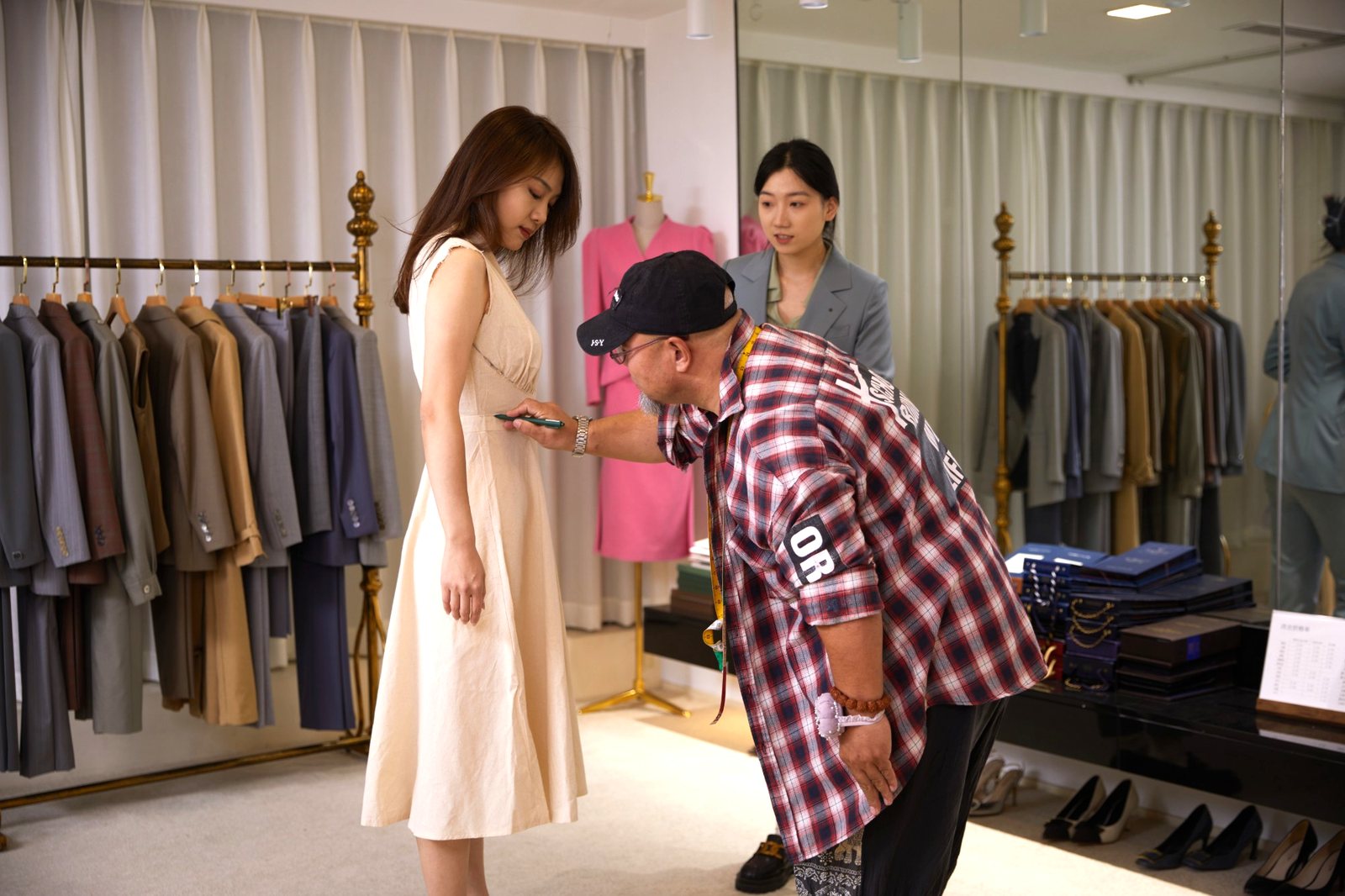
Refining the design before cutting the final fabric

On fittings, choices, and how a garment comes to belong to one person.

In the atelier, a fitter marks the cut on a client while a colleague looks on

Decisions begin with the wearer

Couture is not about selling a client a more expensive garment. It is about making each of her choices more exact.

People buy a great many clothes and then find, back in their own lives, that the pieces are hard to combine, wrong for the actual occasion, and end up sitting in the wardrobe. The material, the labour and the time have all been spent, and the garment never entered the wearer's life at all.

What LADIAQUA understands by couture is this: over the course of making, we establish step by step the wearer's body, her role, the way she lives and what she quietly hopes for - so that the finished garment suits her, and stands a better chance of being kept and worn again and again.

A fitting before the final fabric

Before the intended fabric is cut, we usually make a toile. A real fitting lets us confirm length, ease, waistline, shoulder construction, neckline, sleeve and overall proportion, and adjust them to the client's body and to the setting the garment is for.

The earlier those judgements are settled, the less likely the intended fabric is to be unpicked or recut. The point of a toile is not to add a formality - it is to see the relationship between the design and the person more clearly, before the final making begins.

Giving the toile continued use

For toiles we look first to stock remnants already in the industry, choosing material as close as we can to the intended fabric in weight, drape, stretch and structural behaviour. It need not be identical, but it must show the silhouette and the feel of wearing accurately.

Where no suitable remnant can be found, we may use a reasonably priced ordinary dress fabric. After the fitting, the toile is not simply discarded. Depending on its actual condition we carry the sewing and the details through to completion, so that it becomes a finished garment that can be shown, tried on or sold. If the client it was made for likes it, she is welcome to keep it.

One fitting, more than one answer

To avoid making the same thing twice, we try to settle as many judgements as possible on a single toile. The left and right sides may be made with different sleeves, cuffs or trouser openings, so the client can compare them directly in one fitting. For asymmetric designs, different directions, lengths and constructions can be shown at the same time.

Some changes cannot be shown together on one toile - moving between a round, a square and a V neckline, for instance. There we use digital imaging, with AI assistance, to present the alternatives. A digital image is no substitute for a real fitting, but it helps the client understand the design directly, and saves making another toile just to compare one detail.

Clothes made for real life

We do not think sustainability lives only in the name of a fabric or on a certification label. It also lives in each judgement made while designing and making: understand the real need before deciding how to build; confirm it in a toile before cutting the intended cloth; give the materials and toiles continued use.

When a garment truly suits its wearer's body, her life and her wardrobe, it has a far better chance of being worn for a long time. One unnecessary remake avoided is also one finished garment less likely to sit idle. That is the value couture ought to provide, and it is how LADIAQUA understands its responsibility.

Back to Design